
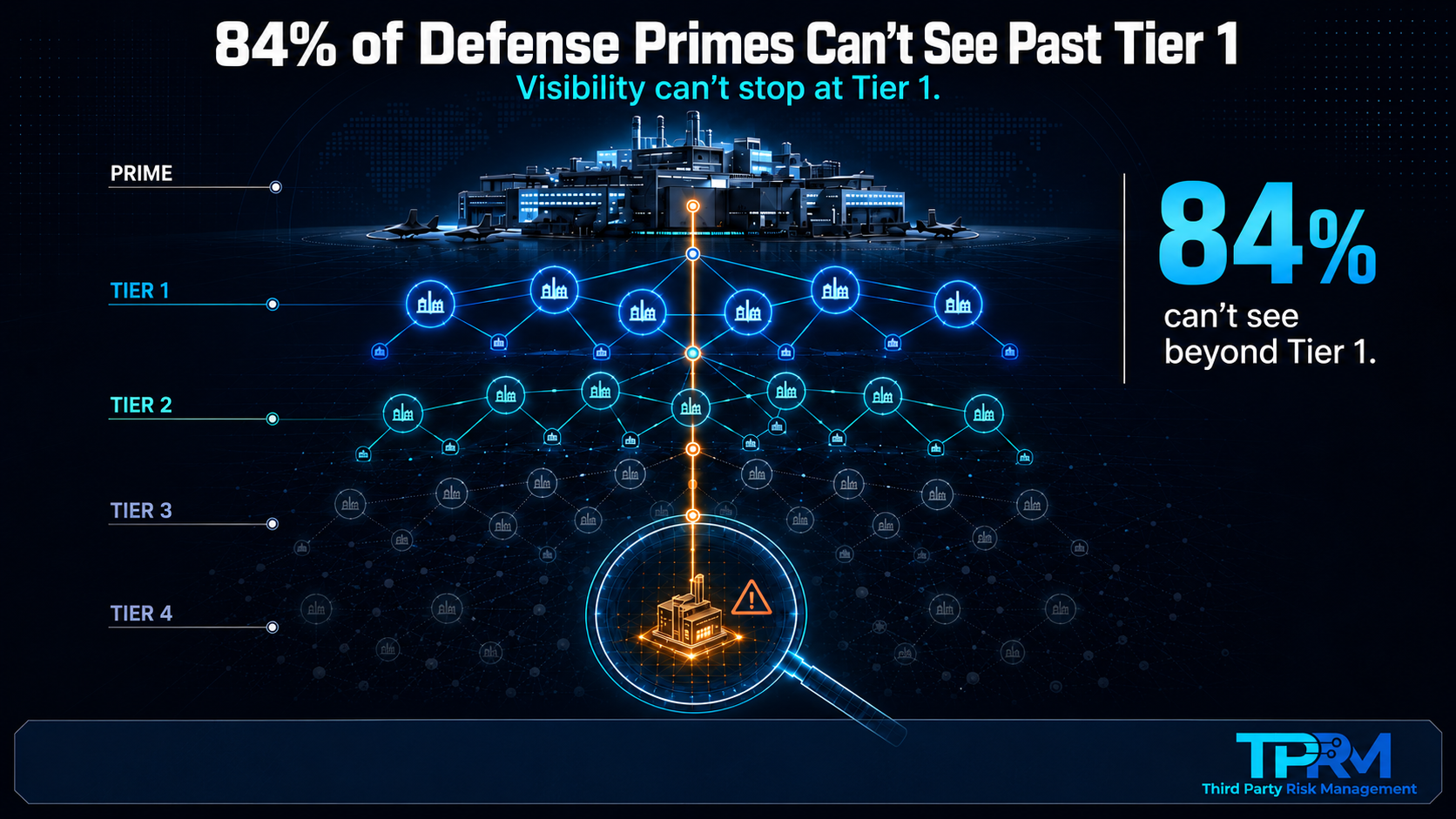
Why 84 Percent of Primes Cannot See Past Their First Supplier
TPRM in Defense has concentrated assurance at the point of greatest contractual visibility - the prime contractor and Tier1 suppliers. Current strain is exposing how little that visibility protects against, because the vulnerabilities capable of halting a weapons programme sit several tiers down, in specialty castings, forgings and microelectronics that most primes cannot see. January 2026 defense industrial base analysis puts a figure on the gap: 84% of prime contractors have no visibility beyond their Tier 1 supplier, and the DoD has acknowledged it lacks consistent visibility into lower-tier suppliers, depending on primes for information they do not possess. After a 2021 explosion at the nation's only domestic black powder facility in Minden, Louisiana, ammunition manufacturers had to draw down stockpiles and delay deliveries for nearly two years, because the dependency sat below any contract the Department directly monitored. Aerospace and defense castings compound the problem: they are typically qualified to specific part, process and supplier, so switching sources requires lengthy requalification and testing even where alternatives exist, and lead times on some qualified castings stretch beyond a year.
A May 2026 Army Office of Small Business Programs briefing set out ten Department of War and Army industrial base priorities, including kinetic capabilities and munitions components, strategic and critical materials, advanced manufacturing and castings and forgings, batteries for weapon systems, and electronics including microelectronics - elevating sub-tier manufacturing alongside raw material dependency. Executive Order 14415, signed 20 July 2026, reinforces the point, directing the Department of War to develop policy within 180 days requiring Supplier Risk Assessments and vulnerability mapping to extend to "any tier," not just direct contractual relationships - because serious vulnerabilities sit at lower tiers.
A specialty chemical produced by one plant, a casting made by one qualified foundry, an electronic component with limited packaging capacity available from a single domestic source.
The structural response gaining ground is a shift from relationship-based sub-tier awareness, where Tier 3 dependency is visible only when Tier 1 discloses it - towards a systematic, technology-enabled supply chain mapping maintained beyond any prime's institutional memory. For third-party risk functions supporting the defense sector, the implication is that a vendor risk register calibrated to direct contractual relationships is measuring the wrong population.
The risk that stops a production line rarely originates with the counterparty named on the contract, and building genuine sub-tier visibility - before a surge demand or export restriction forces the question, is becoming a distinguishing capability rather than a theoretical best practice.