Securing the Energy Supply Chain.
From Wellhead to Smart Grid.
Third-Party Risk Management for the Oil & Energy Sector purpose-built for the complexity, scale and regulatory demands of critical energy infrastructure.
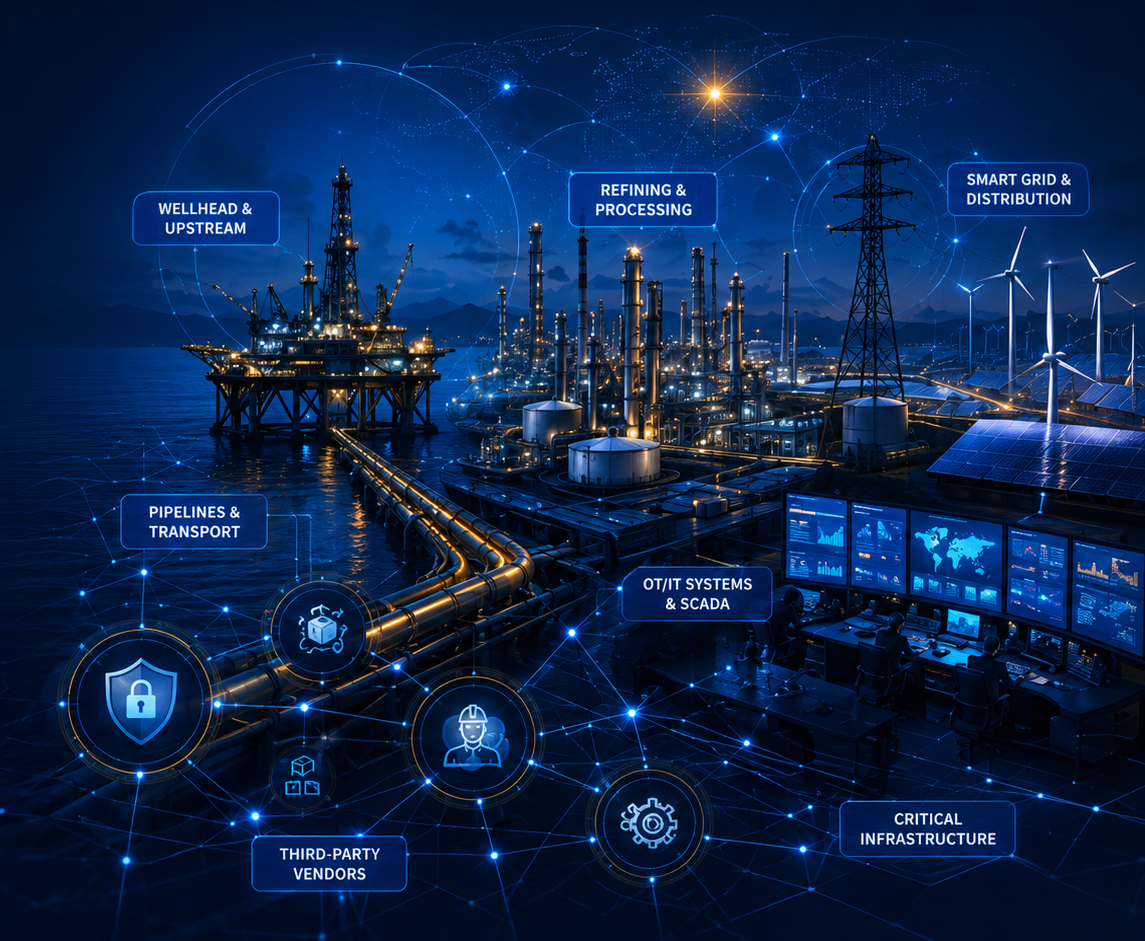
The oil and energy sector operates one of the most complex, interconnected and safety-critical supply chains on the planet. From upstream exploration and production through to downstream distribution, transmission and smart grid technology, every link in the chain carries risk. As the industry digitises at pace - connecting legacy OT and SCADA systems to modern IT networks, cloud platforms and IoT devices - the third-party attack surface has expanded dramatically. Simultaneously, the regulatory landscape is tightening, with governments and regulators demanding that energy organisations not only manage their own cyber and operational risks, but demonstrate active oversight of the vendors, contractors and service providers that underpin their operations.
TPRM Consulting brings nearly two decades of specialist third-party risk management expertise to the oil and energy sector. We understand that risk here is not abstract - it is physical, operational, and increasingly, existential. Our frameworks, assessments and managed services are designed to match the depth, scale and sector-specific nuance that energy supply chain security demands.
Why Third-Party Risk in Oil & Energy Is Different
The oil and energy sector presents a unique third-party risk environment that sets it apartfrom other industries. The combination of critical national infrastructure designation, OT/IT convergence, geopolitical exposure, long and complex supply chains, and rapidly evolving regulation means that a generic TPRM approach is insufficient. The risks here can cascade - a compromise in one supplier can affect physical equipment, disrupt grid stability, or create national security incidents.
Energy organisations manage relationships with hundreds, often thousands, of third parties simultaneously: EPC (engineering, procurement and construction) contractors, SCADA software providers, field device manufacturers, metering and grid management software suppliers, logistics and maintenance contractors, cloud and IT managed service providers, and an extensive network of sub-contractors operating at fourth and fifth-party level.
These are not theoretical risks. They are the lived reality of an industry whose supply chain vulnerabilities have been demonstrated repeatedly by nation-state actors, ransom waregroups, and supply-chain compromise campaigns targeting OT infrastructure.
The OT/IT Convergence Risk Nexus
OT/IT Convergence Risk
Supplier access can become a pathway to physical disruption.
The convergence of Operational Technology (OT) and Information Technology (IT) is one of the defining risk challenges of the energy sector's digital transformation. Legacy SCADA systems,distributed control systems (DCS) and industrial automation platforms - many of which were designed before the internet existed - are now being connected to cloud environments,remote access services, and vendor-managed platforms.
This creates a compounded third-party risk: vendors providing remote access services, firmware updates, or field maintenance are potential entry points into safety-critical systems.A vulnerability at a subcontracted software vendor can propagate directly into physical operational environments, with consequences that extend far beyond a data breach.
Geopolitical Risk:
A Sector-Specific Dimension
The energy sector operates globally, across jurisdictions with widely varying political stability,sanctions exposure and state-level cyber threat profiles. Third-party supply chains routinely span politically sensitive regions – from Middle Eastern field operations to Eastern Europeanlogistics and East Asian component manufacturing.
In March 2026, the NCSC issued a specific alert highlighting heightened risk for organisationsand entities with supply chains in the Middle East. Russia has routinely deployed destructive malware against energy infrastructure in conflict zones, and in January 2026, CERT Polska attributed an attack on key renewable infrastructure directly to Russian actors – an attack that affected both IT systems and physical industrial equipment.
The Regulatory Horizon - What Energy Organisations Must Now Navigate
The regulatory environment for oil and energy supply chain security is undergoing its most significant transformation in a generation. Multiple overlapping frameworks and pieces of legislation are converging to impose direct and enforceable obligations on energy organisations and their supply chains.
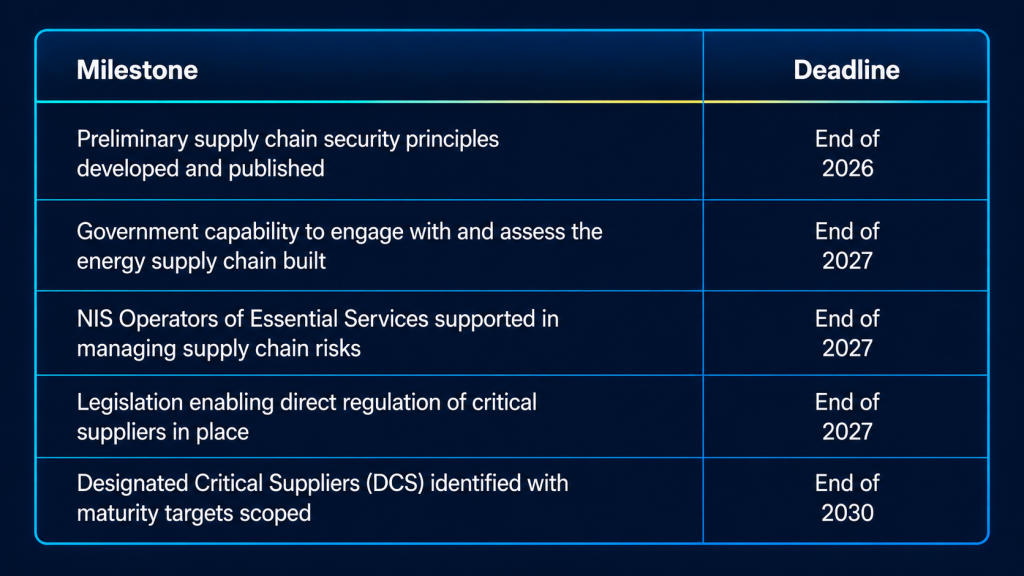
UK Energy Sector Cyber Security Strategy 2026–2030
Published by the UK Government on 28 May 2026 – jointly by the Department for EnergySecurity and Net Zero (DESNZ), Ofgem, the NCSC and the National Energy System Operator(NESO) – this four-year roadmap sets out binding and time-bound obligations specificallytargeting supply chain security
The strategy explicitly states that energy sector boards must treat cyber risk – and by extension, supply chain risk – “with the same seriousness as safety, reliability and operational resilience.” It calls for energy organisations to identify, assess and manage cyber risks across critical systems, critical suppliers, and high-impact points of failure
Ofgem Supply Chain Security Guidance (Consultation Closed June 2026)
Ofgem published draft supply chain security guidance for the downstream gas and electricity sector in June 2026, with a consultation closing on 29 June 2026. The guidance introduces a risk-based supplier criticality model and establishes concrete expectations for supply chain risk management that go well beyond previous NIS obligations
The Ofgem Adapted Cyber Assessment Framework (CAF) Profile for energy operators already mandates specific TPRM requirements for Operators of Essential Services
The UK Cyber Security and Resilience Bill
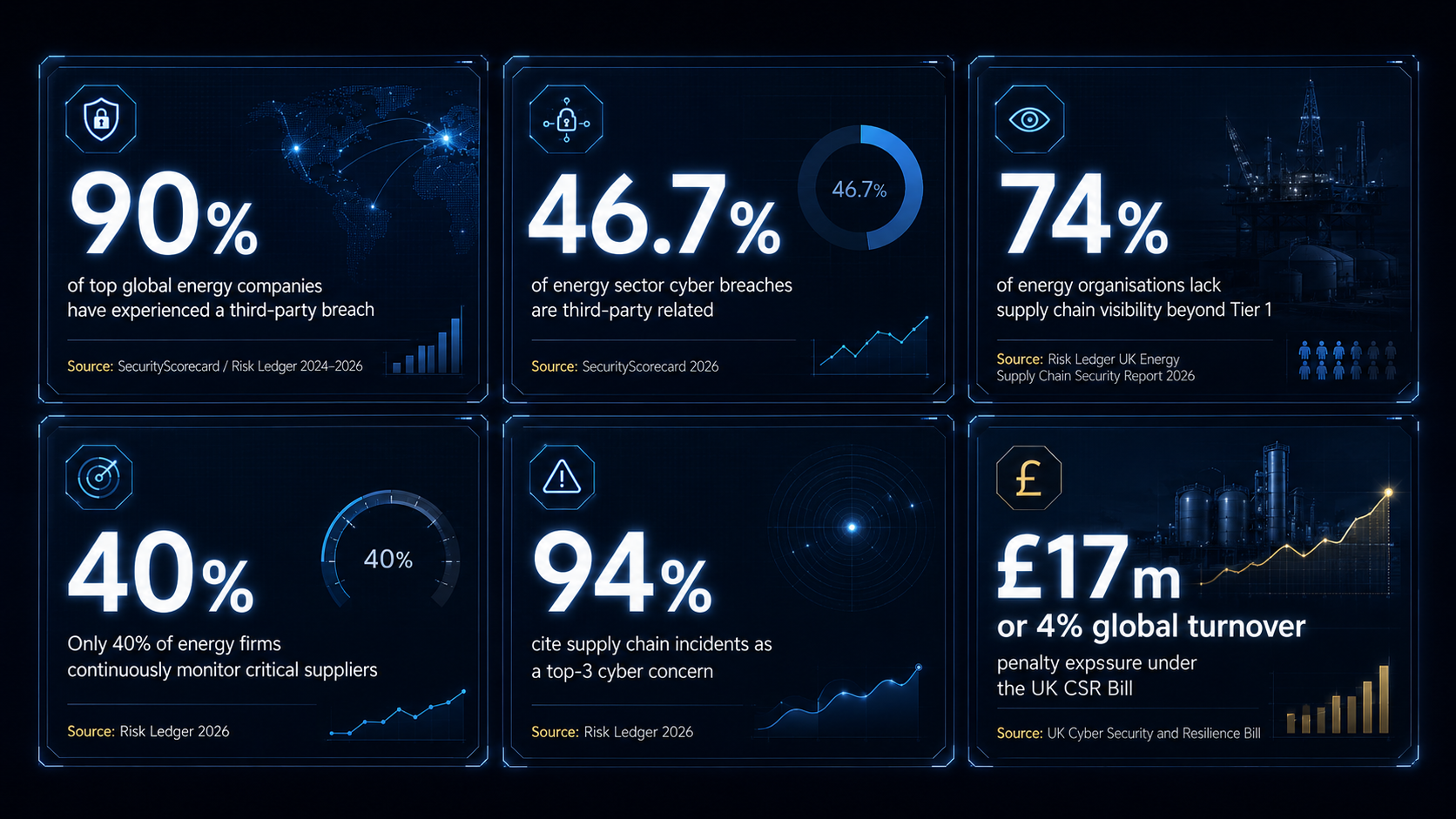
Introduced to Parliament in November 2025, the Cyber Security and Resilience (CSR) Bill will significantly expand the UK’s NIS regulatory scope and introduce tighter supply chain obligations.
Key provisions directly relevant to energy supply chain security:
NIS Regulations (UK) and EU NIS2
The UK NIS Regulations 2018 remain the foundational regulatory instrument for Operators ofEssential Services in the energy sector. DESNZ acts as NIS regulator for Oil and Upstream Gas;Ofgem and DESNZ jointly regulate Downstream Gas and Electricity.
The EU’s NIS2 Directive (effective January 2023) classifies energy – including electricity, oil,gas and hydrogen – as an Essential Entity sector subject to the strictest requirements,including mandatory supply chain security audits and contractual security obligations across the vendor ecosystem. UK-headquartered organisations with EU operations or EU-customer-facing services face dual compliance obligations under both frameworks
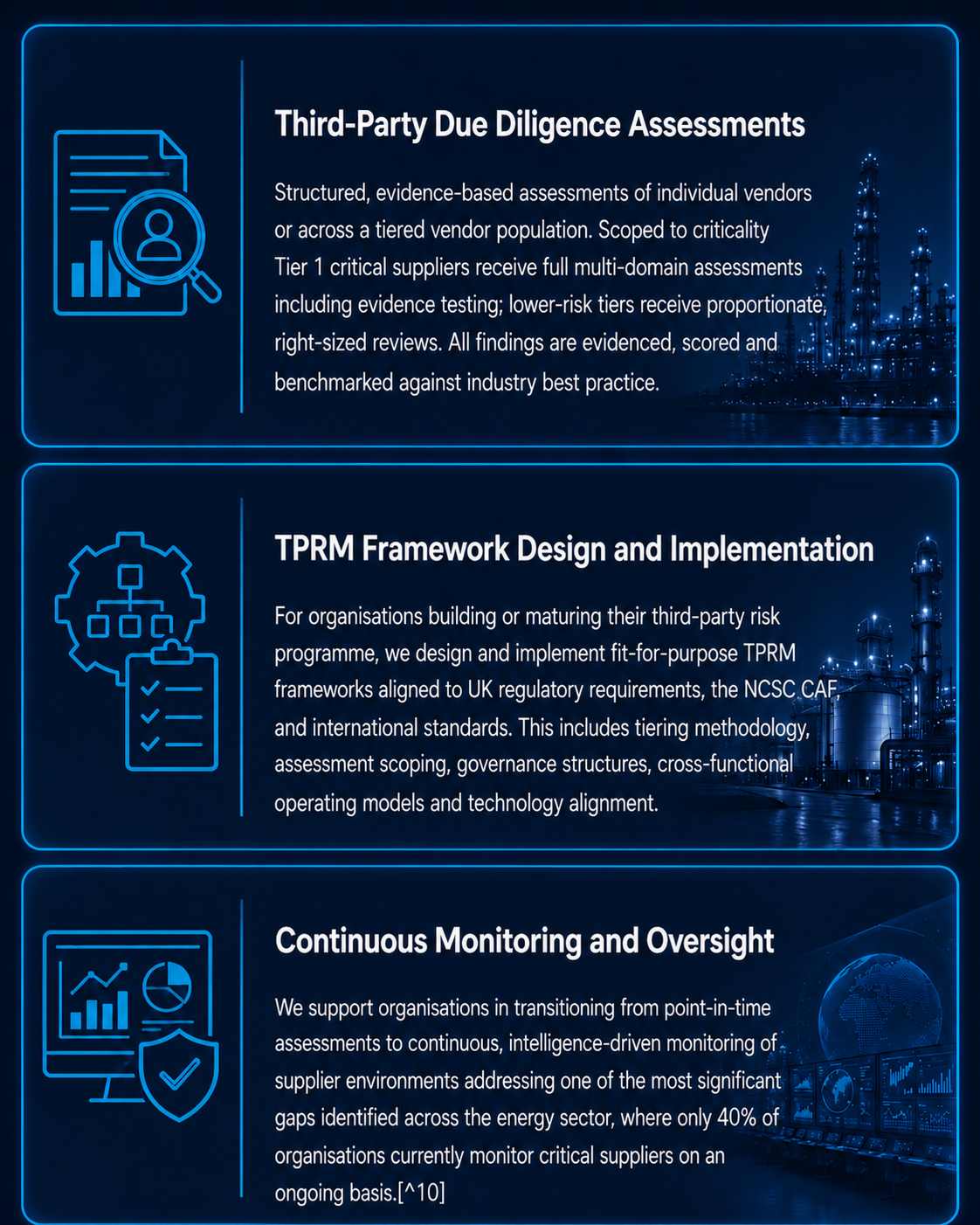
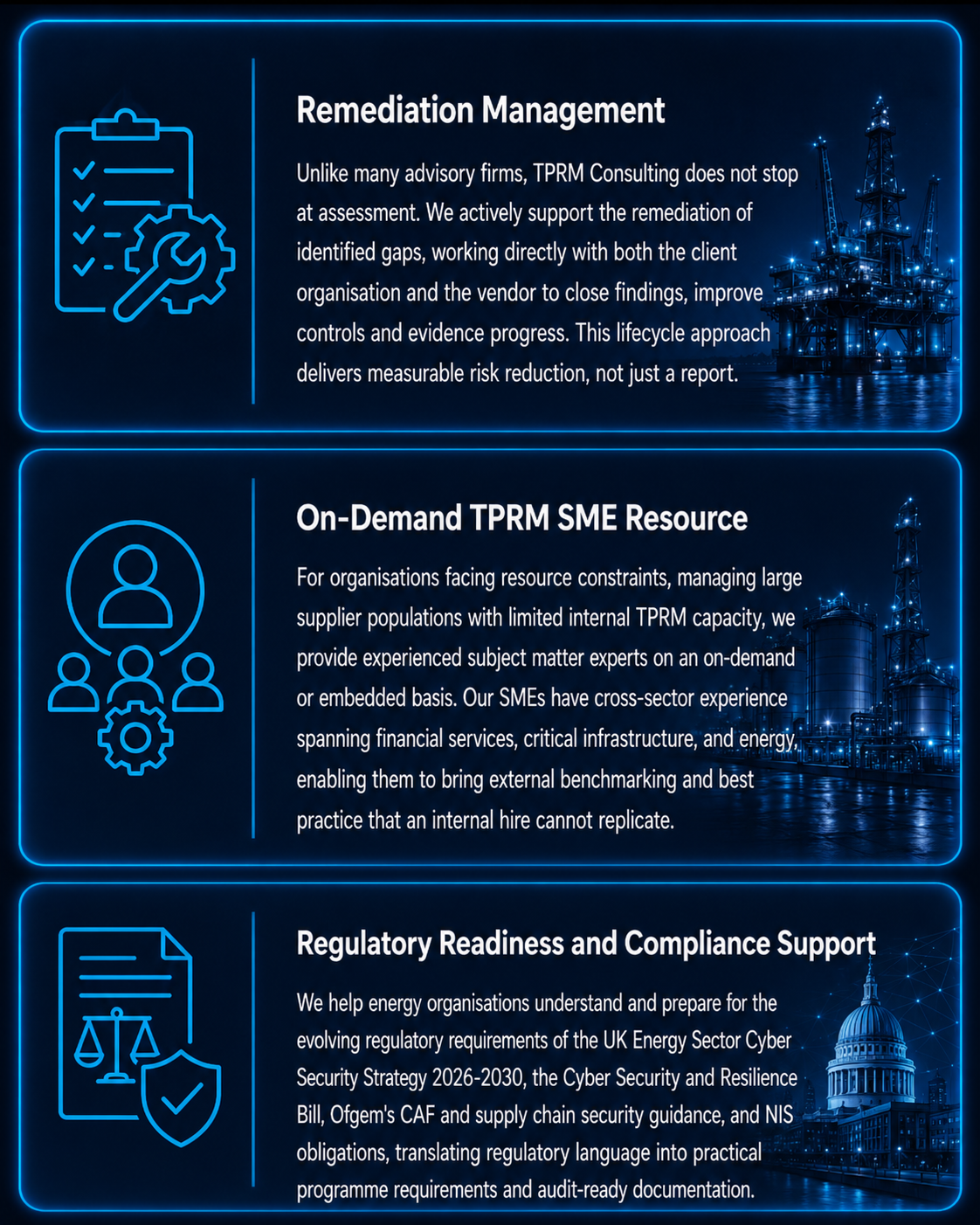
Our Oil & Energy TPRM Services - End-to-End, Evidence-Based, Sector-Specific
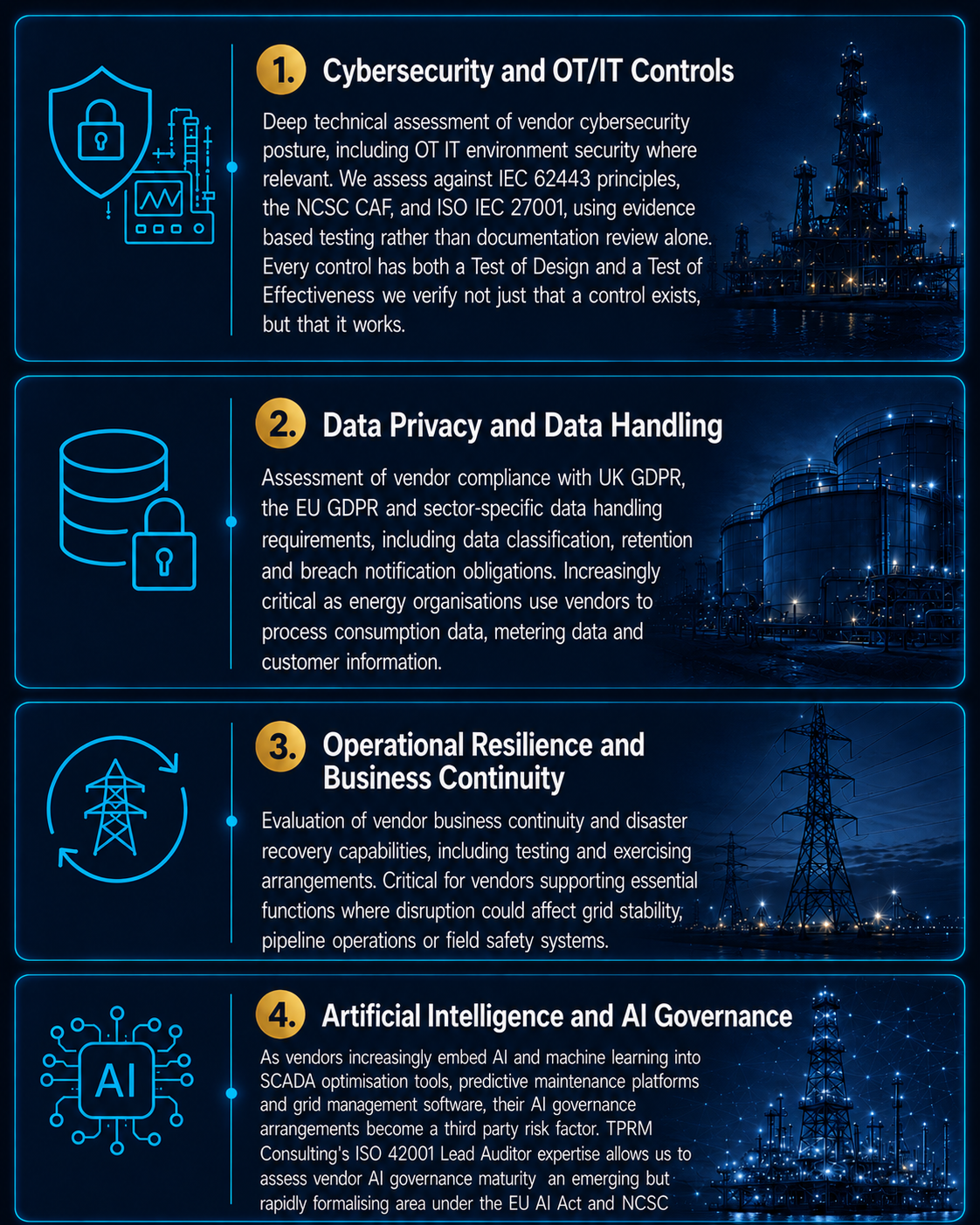
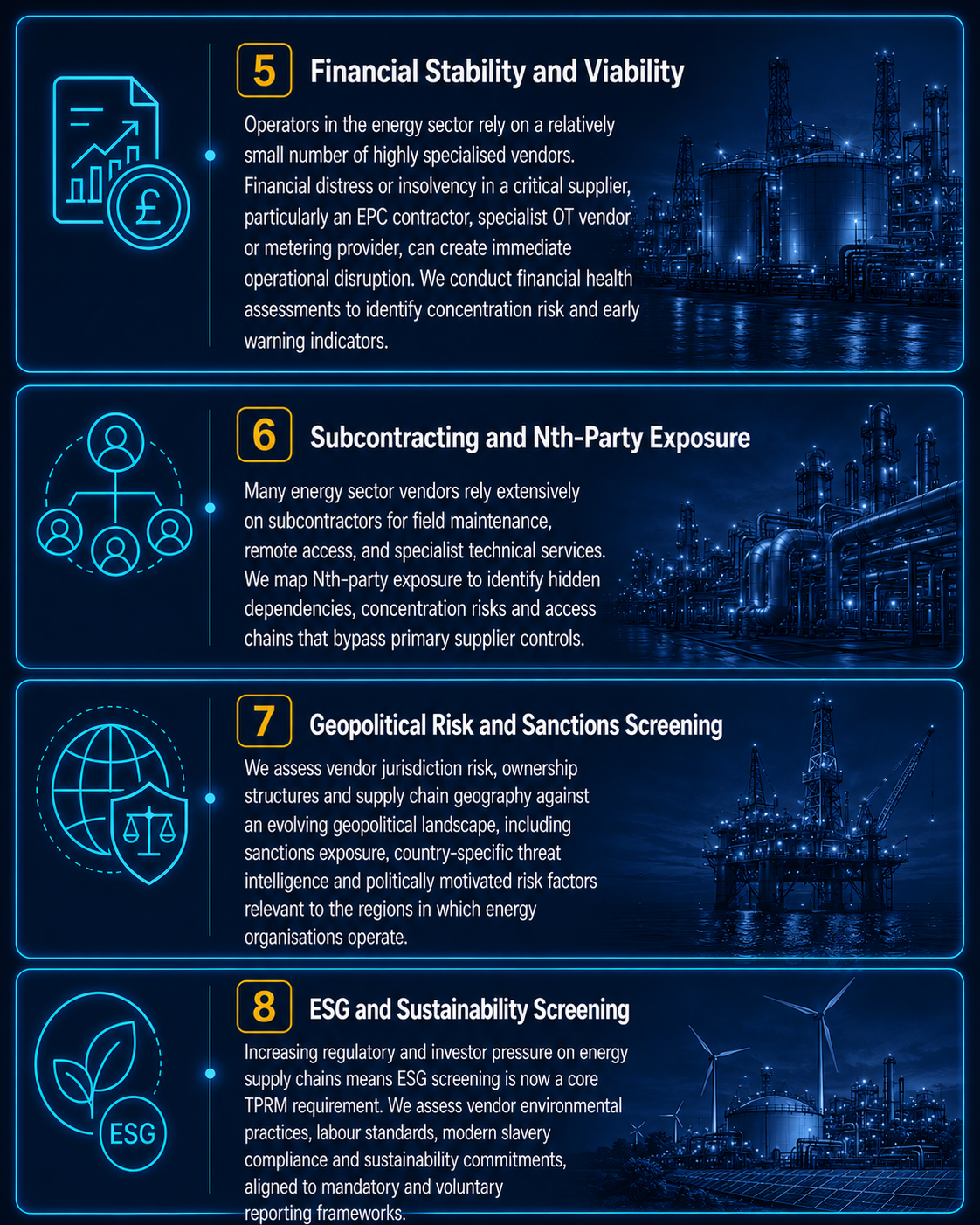
TPRM Consulting delivers specialist third-party risk management services designed specificallyfor the operational, regulatory and risk environment of the oil and energy sector. Ourapproach goes well beyond cyber assessment alone – we assess the full spectrum of third-party risk domains that matter to energy organisations.
Every vendor relationship TPRM Consulting assesses is examined across the following riskdomains, scoped by criticality and service type:
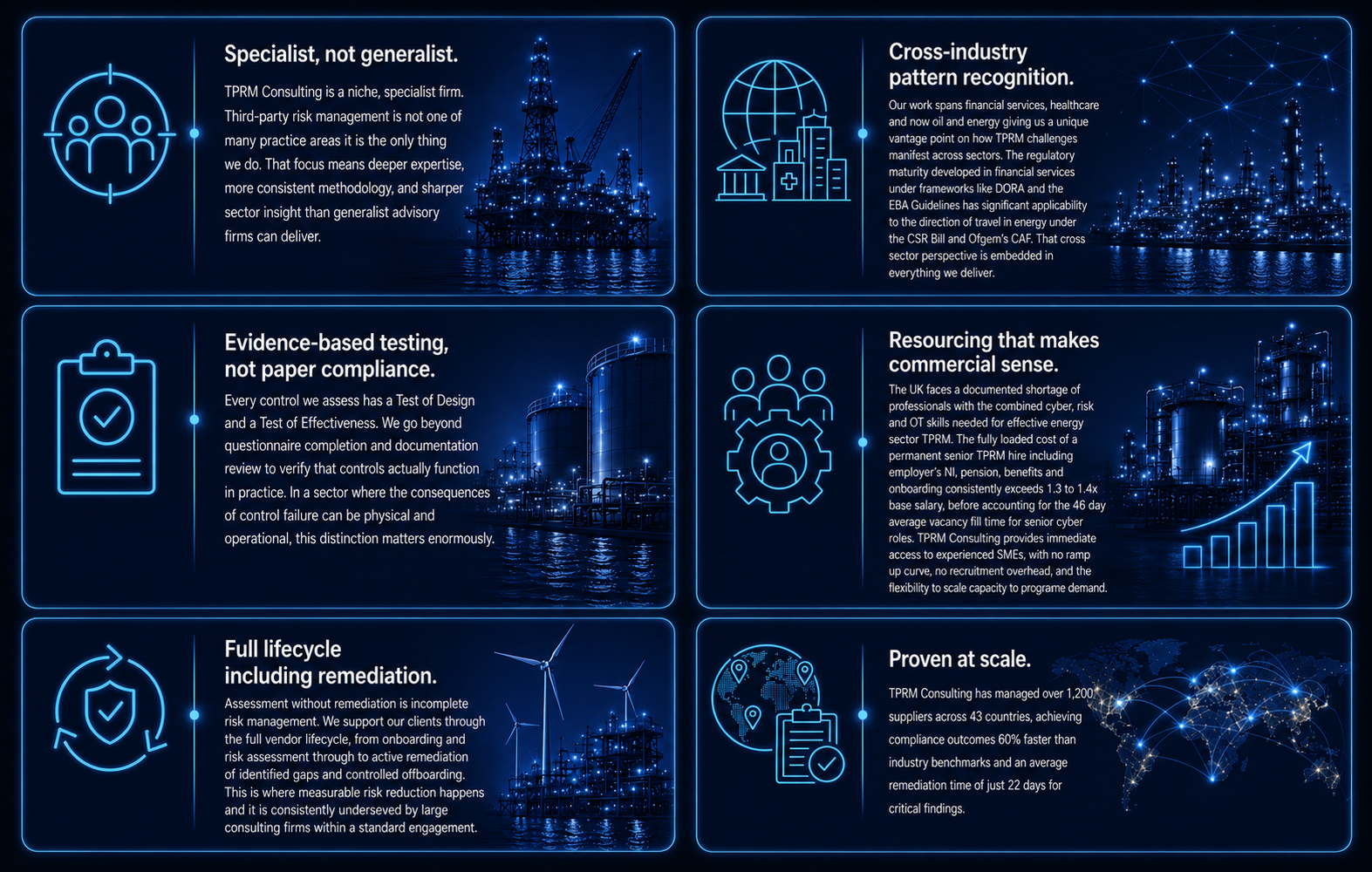
Why Organisations Choose TPRM Consulting
Start with Confidence - Our Proof of Value Engagement
For organisations evaluating their TPRM approach or considering external specialist supportfor the first time, TPRM Consulting offers a structured Proof of Value engagement. In afocused, time-bound exercise, we demonstrate our methodology against a real andrepresentative selection of your supplier population – giving you tangible, evidence-basedoutput before committing to a broader programme.
The Proof of Value is designed to:
Sector Perspectives and Resources
The TPRM Consulting team is active at industry conferences and forums across Europe,including events focused on supply chain security, operational resilience, and cyber risk in critical infrastructure. Our Insights section includes articles, video content, and regulatory horizon-scanning specifically relevant to the oil and energy sector’s third-party risk challenges.
Ready to Strengthen Your Energy Supply Chain?
Whether you are building a TPRM programme from the ground up, maturing an existing oneahead of regulatory deadlines, or looking to augment your team with experienced SMEresource, TPRM Consulting is ready to help.